
Am I inherently against property Investment? Why am I so critical of India’s real estate market? Why do I question builders, banks, brokers, and government policies? And why do I rarely recommend property as an investment, even though real estate is widely considered one of India’s most preferred wealth-building assets?
Everyone makes an impression as though I am inherently against real estate. Why am I so-much anti-builder? Why I never endorse real estate? Why I never mention advantages of property, like I do with gold.
Actually, all these questions are same but also different questions
First issue: Real estate from public policy perspective – this business is just cash cow for government, but there is no accountability & no transparency. RERA is just an eye wash. The fact is that property transactions help government revenue. It unofficially also helps those in power; it is an avenue to accommodate cash generation by the vested interest.
Second issue: Builders’ conduct needs to be examined. As far as my anti-builder stance is concerned, reasons are builders’ conduct of exploitation. There is a long history of builder exploitating the buyers in India, and examples galore. Absence of right laws, and right endorsement makes it worse for buyers
In this column, I explain why I remain critical of real estate as an investment product and why my criticism is not simply about builders or property prices.
The bigger question is: Who really benefits from India’s booming property market, the government, builders, banks, brokers, or the ordinary homebuyer?
The real estate investment debate nobody wants to have
Property investment is often promoted as a safe and reliable way to build long-term wealth. But investors rarely evaluate its complete financial cost.
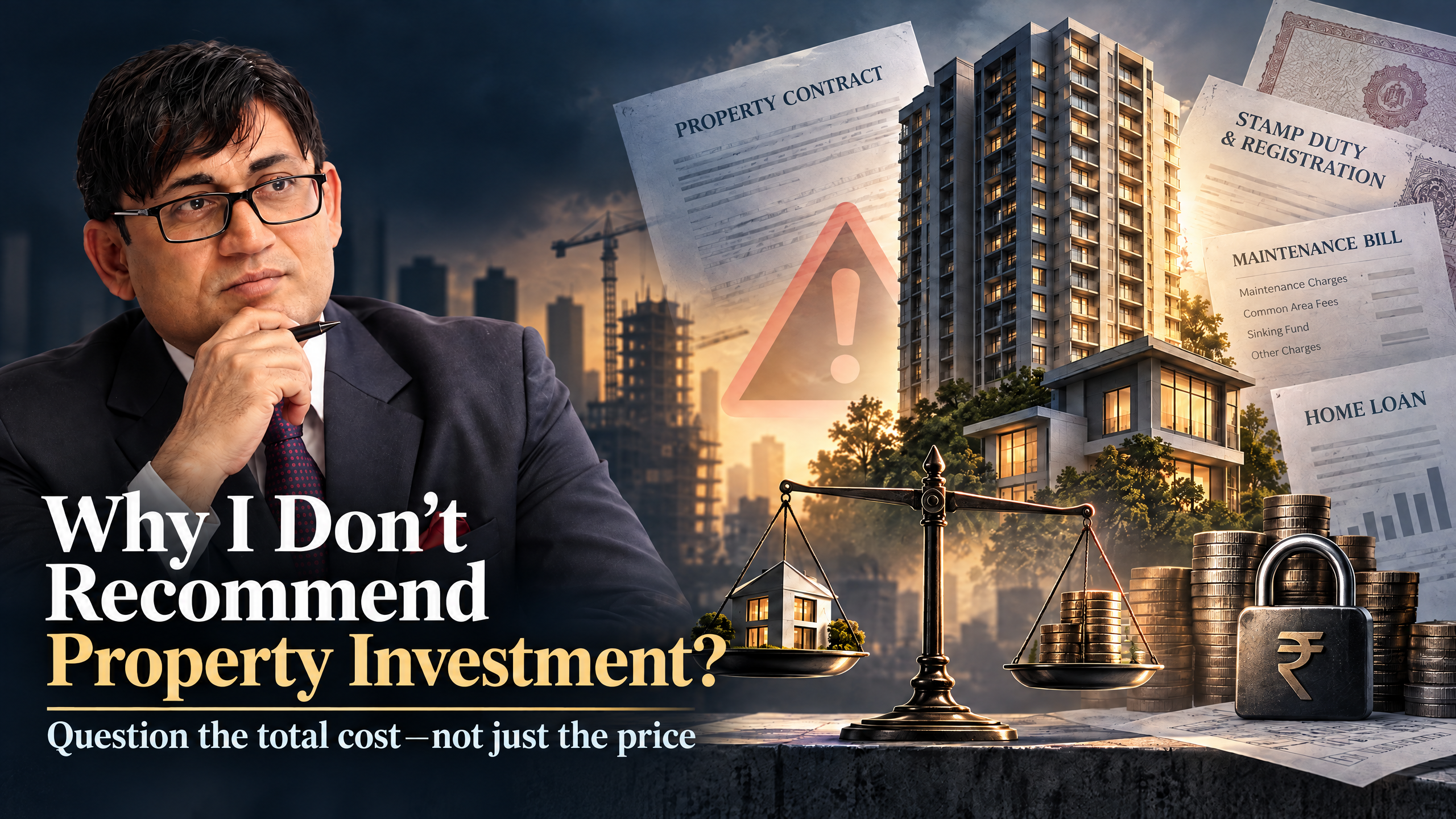
Stamp duty, registration charges, applicable GST, maintenance expenses, transaction costs, illiquidity, and opportunity costs can significantly affect the actual return on investment.
And beyond financial calculations, there are deeper structural questions about India’s real estate ecosystem.
Is real estate primarily a housing necessity, an investment asset, or a revenue-generating mechanism for governments and businesses?
Are India’s regulatory institutions adequately protecting homebuyers?
And does the property market genuinely offer a fair risk-reward equation for an average Indian investor?
What we need to understand about real estate business?
To understand real estate in India, one has to delve deeper and see the incentive structure of the business, and how it facilitates the common consumers’ exploitation. Following issues need to be understood:
Government & Real Estate: Why property transactions generate substantial government revenue and how this influences the real estate ecosystem?
Political & Bureaucratic Interests: Questions surrounding vested interests, transparency, and black money in land and property transactions.
RERA & Consumer Protection: Why I question the effectiveness of India’s real estate regulatory framework?
Builder Conduct: The history of homebuyer disputes involving projects associated with Amrapali, Jaypee, Unitech, Supertech, and many more.
Builder-Bank Nexus: Why lending practices and questionable project financing deserve greater scrutiny? Even Supreme Court has been critical of this.
Property Brokers: How aggressive selling and misrepresentation can distort homebuyers’ decisions? Everyone is a broker in this free-for-all ecosystem.
Hidden Investment Costs: The often-overlooked expenses of entering, holding, and exiting property investments. This makes real estate the least valuable asset for a common man.
Real Estate ROI: Why property appreciation alone cannot determine investment profitability.
Opportunity Cost: How real estate compares with alternative investments when liquidity, expenses, and returns are considered? A closer look with once again expose property as least valuable asset.
Who Should Buy Property? Why the right decision depends on personal net worth, financial circumstances, and life stage? Someone buying a house on loan without financial safety net is just a victim of market hype built around property business.
My central argument
I am not against owning a home. I question whether buying property is always a financially sensible investment decision. A good property is not necessarily a good investment for every buyer.
An investment must be evaluated through its total acquisition cost, holding expenses, expected returns, liquidity, opportunity cost, and financial suitability.
For an average Indian household with limited net worth, concentrating a substantial portion of wealth in a single illiquid asset can have significant financial consequences.
This is why the debate should not simply be about whether property prices will rise.
The real questions are: Why should you buy property? When should you buy it? And how much of your total net worth should you commit to it?
Just ask yourself: Do you believe real estate is still the safest investment for Indian households?
Have you calculated the actual return on your property investment after accounting for all expenses?
And do you think India’s real estate market adequately protects ordinary homebuyers?
Answers would put an end to the query: Why I am against real estate investment?
Ravi Sinha